Business
Updated:
Introduction: The Messaging Channel That Changes Everything
Enterprise messaging has a trust problem. Email open rates hover around 20%. SMS click-through rates are declining as consumers grow numb to generic promotional blasts. Push notifications are aggressively muted. Customers, however, still expect instant, contextual, and visually compelling conversations from the brands they engage with. This is precisely where RCS Business Messaging steps in. Not as an incremental improvement to SMS, but as a fundamentally different enterprise communication channel.
RCS (Rich Communication Services) delivers app-like experiences directly inside a user's native messaging inbox. For businesses navigating fragmented customer communication stacks, RCS represents one of the most significant strategic opportunities available today. RCS now surpasses 2.1 billion active users globally, and Apple's decision to support RCS on iOS removed the last major barrier to universal adoption. For enterprise marketing, CX, and sales teams, 2026 is the year to move from pilots into production-scale deployment.
Deploying RCS effectively requires more than enabling the channel. It demands a deliberate strategy around message design, journey architecture, AI integration, and omnichannel orchestration. This guide breaks down exactly how forward-thinking enterprises are executing that strategy and why RCS belongs at the center of your customer engagement stack.
Why RCS Is the Enterprise Messaging Channel for 2026 and Beyond
The Structural Limitations of SMS Are No Longer Acceptable
SMS was built for a different era. Its 160-character limit, lack of media support, and zero interactivity made it adequate for OTP delivery and basic alerts. As customer expectations have evolved, the gap between what SMS offers and what customers actually want has become untenable.
The numbers tell the story clearly:
SMS click-through rates average 4 to 6%, while RCS campaigns consistently deliver 15 to 35% engagement rates in pilot programs across retail, banking, and telecom.
Brand recall for RCS messages with rich media is up to 4x higher than plain-text SMS.
Conversion rates for RCS campaigns with interactive CTAs outperform standard SMS by 2 to 3x in A/B tests conducted by major carriers.
These are not marketing projections. They reflect the structural difference between a channel that delivers static text and one that supports branded, visual, interactive storytelling.
What Makes RCS Different: A Feature-Level Breakdown
For enterprise marketers and CX architects, the RCS feature set unlocks workflows that were previously impossible in the SMS channel.
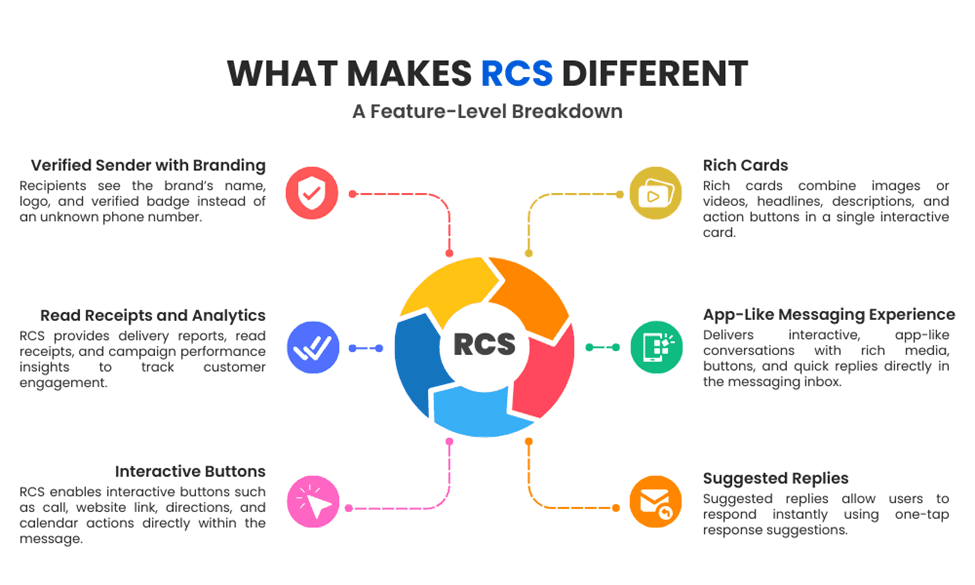
Rich Cards
Rich cards combine an image or video, a headline, a description, and up to three action buttons in a single card format. A retail brand can display a product image with "Buy Now," "View More," or "Save for Later" buttons, all delivered inside the native messaging app.
Carousels
Carousels extend the rich card format into multiple swipeable cards within a single message. This is powerful for e-commerce product discovery, event showcases, and menu-driven navigation. A travel brand can send a carousel of holiday packages, each with an image, itinerary summary, price point, and a "Book Now" CTA, all within one message thread.
Suggested Replies
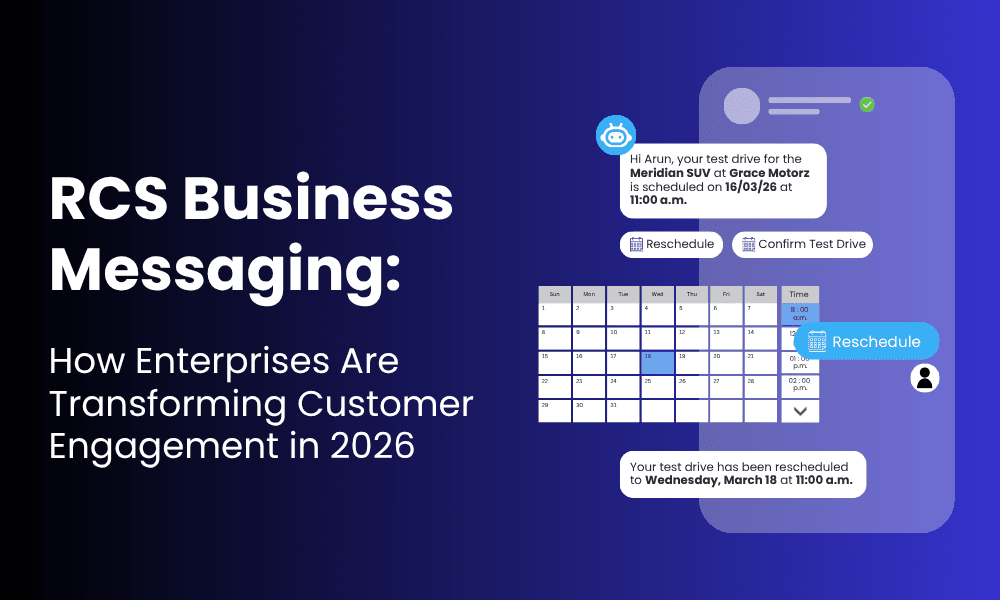
Suggested replies are one-tap response chips that appear beneath a message. They reduce friction in customer journeys by surfacing contextual, pre-configured response options. Instead of typing "Yes, reschedule please," the customer simply taps "Reschedule." This feature is foundational to building automated, AI-powered conversational flows.
Interactive Buttons
Beyond suggested replies, RCS supports URL buttons (deep links to web pages or apps), dial buttons (initiating a phone call), calendar actions, and map location sharing. These transform a passive notification into an active, transactional touchpoint.
Verified Sender with Branding
Recipients see the brand's name, logo, and a verified checkmark rather than an unknown number. This increases trust and open rates, addressing one of the most persistent challenges in enterprise SMS communication.
Read Receipts and Delivery Analytics
RCS provides businesses with confirmed delivery and read data that SMS cannot provide. Marketers can measure actual message engagement, not just delivery, enabling far more precise campaign attribution and follow-up sequencing.
RCS vs SMS vs WhatsApp: A Strategic Comparison for Enterprise Teams
Enterprise messaging leaders are often asked a pointed question: if we are already on WhatsApp Business API, do we need RCS? The answer requires a nuanced lens.
The Channel Positioning Matrix
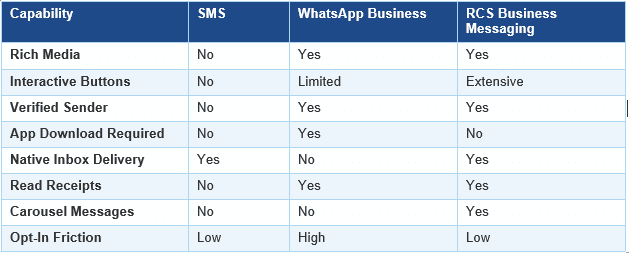
The critical differentiator is straightforward: RCS delivers WhatsApp-level richness through the native SMS inbox with no app installation required. For enterprises targeting broad consumer audiences, particularly in markets where WhatsApp penetration is uneven or where iOS adoption is high, RCS offers meaningful incremental reach.
The strategic recommendation is not to replace WhatsApp with RCS, but to architect an omnichannel messaging strategy that leverages each channel's strengths. High-intent customers already engaged on WhatsApp can stay there. RCS captures the broader base that has not opted into a third-party messaging app but still carries a smartphone.
AI + RCS: The Architecture That Powers Enterprise-Scale Conversations
The most transformative RCS deployments are not static campaign sends. They are AI-orchestrated conversation flows that adapt in real time to customer signals, behavioral history, and intent.
How Agentic AI Transforms RCS Messaging
When an AI agent is integrated with the RCS channel, the conversation becomes dynamic rather than scripted. The AI can:
Personalize message content at the individual level using customer purchase history, CRM data, and real-time session behavior
Interpret open-ended natural language inputs and route them to the appropriate resolution flow
Escalate intelligently by detecting frustration signals or high-value customer indicators and routing to a human agent when appropriate
Trigger contextual follow-ups based on in-message engagement, such as initiating a follow-up offer 24 hours after a customer views a product card without purchasing
Platforms like Chat360 enable businesses to deploy AI-powered RCS messaging at scale, integrating automation, customer journeys, and analytics into a single omnichannel platform, so RCS functions as a connected layer within a broader CX architecture rather than a siloed channel.
RCS as Part of an Omnichannel Sequence
In a mature omnichannel strategy, RCS functions as one node in a larger conversation graph. A typical enterprise orchestration works like this:
Awareness: A WhatsApp or email campaign creates awareness of a product offer.
Engagement: An RCS follow-up with a rich card and CTA reaches non-WhatsApp users.
Consideration: An AI-powered RCS conversation handles product questions and surfaces comparison carousels.
Conversion: An in-message purchase button or deep link closes the transaction.
Retention: An RCS post-purchase journey covers upsell, loyalty enrollment, and feedback collection.
Reactivation: A targeted RCS campaign with a personalized offer rich card drives re-engagement.
Every step is measurable, every branch is data-driven, and every interaction is enriched by a shared customer intelligence layer.
Enterprise Implementation Considerations
Verified Sender Registration
Enterprises must submit brand verification, logo, description, and acceptable use documentation through the RCS business messaging platform. This upfront effort is precisely what makes RCS a high-trust channel. A verified RCS sender cannot be spoofed; customers see a blue checkmark confirming sender identity.
Fallback Strategy to SMS
Not every recipient will have RCS-enabled devices or carriers. A well-architected deployment includes intelligent channel fallback logic that automatically downgrades to SMS when the recipient's device does not support RCS. This ensures 100% message delivery coverage without requiring separate campaign management.
Compliance and Opt-Out Management
Enterprises must maintain clean opt-in records, honor opt-out requests within required timeframes, and adhere to message frequency guidelines. Integration with a consent management platform is strongly recommended for regulated industries including financial services, healthcare, and insurance.
CRM and Marketing Automation Integration
CRM connectivity enables true 1:1 personalization. Marketing automation platform integration allows RCS to participate in multi-step campaign workflows. CDP integration enables real-time behavioral segmentation, and analytics integration ensures RCS campaign data feeds back into existing attribution and reporting systems.
Conclusion: RCS Is an Infrastructure Decision, Not Just a Channel Choice
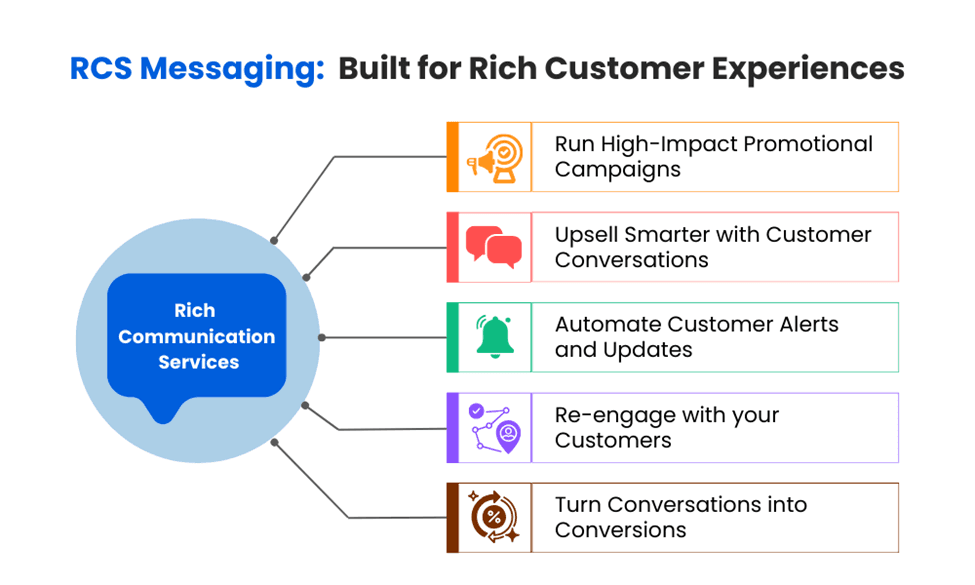
RCS is a fundamentally new customer engagement infrastructure that merges the reach of SMS, the richness of app-like experiences, and the intelligence of AI-driven conversation orchestration. The organizations gaining the most from RCS have embedded it within a broader omnichannel strategy, by connecting it to their customer data systems, and empowered it with conversational AI.