Business
Updated:
The Shift Nobody Planned For
When McKinsey reported that companies excelling at personalization generate 40% more revenue than average performers, most enterprises scrambled to invest in CRM platforms, CDP tools, and omnichannel orchestration layers. Very few looked at their messaging stack and that's precisely where the gap is widening.
Mobile messaging is no longer a notification channel. It is the primary interface through which consumers make high-intent decisions: they research, compare, question, and convert ,all within the same thread. Yet the majority of enterprise messaging strategies are still built on a 30-year-old protocol.
RCS (Rich Communication Services) has quietly crossed a critical threshold: over 1 billion active RCS users globally as of 2024, with Apple's iOS 18 finally adopting the standard. This isn't a technology preview anymore. It's a live commercial channel and the enterprises that treat it as such will structurally outperform those that don't.
This post isn't about what RCS is. It's about what RCS does to your funnel, your customer lifetime value, and your competitive positioning and how to operationalize it before the window of asymmetric advantage closes.
The Real Problem Isn't SMS Limitations — It's Revenue Leakage
The conversation around SMS limitations tends to focus on character counts and link truncation. That's the wrong lens. The real damage is structural:
Data fragmentation at scale:
Every SMS click that redirects to a mobile browser creates a new, anonymous session. Your CRM gets a UTM parameter; your analytics platform gets a pageview. But the first-party intent signal in terms of what the customer actually wanted in that moment, disappears. In a post-cookie world, this is not a minor inconvenience. It's a direct hit to attribution fidelity.
The interactivity illusion:
Brands have compensated for SMS's low interactivity by building elaborate link-out architectures: SMS → landing page → form → CRM entry → email follow-up. Each step introduces abandonment. Industry data consistently shows that each additional step in a conversion flow drops completion rates by 15–25%. The channel architecture itself is creating churn.
Personalization theatre:
Inserting a customer's first name into an SMS is not personalization. Real personalization requires context-aware branching, behavioural triggers, and in-channel response capture. SMS cannot support any of these natively. The result is messaging that feels personal but converts like a broadcast.
Strategic Insight: The average enterprise loses an estimated 30–40% of its mobile engagement value not because the message fails to deliver but because the channel cannot hold the conversation long enough to convert.
RCS as a Revenue Channel: The C-A-R-I Framework
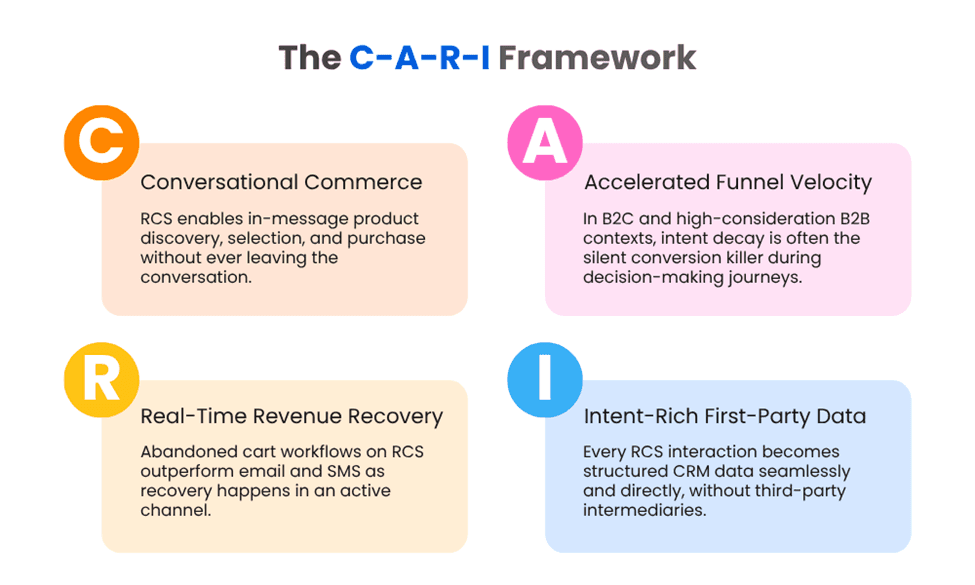
Most RCS coverage stops at features: carousels, suggested replies, verified sender badges.. The more accurate frame is commercial infrastructure and we can map its revenue potential through what we call the CARI Framework:
C — Conversational Commerce
RCS enables in-message product discovery, selection, and purchase without ever leaving the conversation. A retail brand can serve a personalized product carousel, receive a tap-to-select response, trigger a payment gateway, and confirm the order, all within a single RCS thread. This collapses a 5-step funnel into a single session.
A — Accelerated Funnel Velocity
In B2C and high-consideration B2B contexts, intent decay is the silent conversion killer. The faster a brand can move from awareness to action, the higher the close rate. RCS's interactive reply capabilities such as quick-reply chips, calendar booking buttons, pre-filled form responses that allow brands to capture micro-commitments in real time, compressing sales cycles measurably.
R — Real-Time Revenue Recovery
Abandoned cart workflows on RCS outperform email and SMS equivalents because the recovery conversation happens in the channel where the customer is already active. Rich media (product image, price, urgency messaging) combined with a one-tap 'Complete Purchase' button creates frictionless re-engagement that email simply cannot replicate.
I — Intent-Rich First-Party Data
Every tap, reply, and interaction in an RCS conversation is a structured data point that flows directly into your CRM without third-party platform intermediaries. This is zero-friction first-party data collection at scale: consent is baked into opt-in mechanics, and the behavioral signals are richer than any cookie trail.
Advanced Use Cases: Beyond Alerts and OTPs
The commodity use cases such as delivery notifications, OTP verification, promotional blasts are not wrong, but they represent roughly 20% of RCS's commercial potential. Here's where the real differentiation lives:
High-Intent Lead Conversion Flows (B2B & B2C)
Consider a real estate developer running Google Ads. A prospect clicks an ad and opts in via an RCS-enabled form. Instead of entering a generic email drip, they receive:
• An RCS message with a video walkthrough of the property
• A quick-reply chip to schedule a site visit (connects to calendar API)
• A follow-up message 24 hours later with a personalized payment calculator
• A one-tap 'Connect with Advisor' button that triggers a call or WhatsApp handoff
This isn't a campaign. It's a guided conversion architecture and it runs entirely within a single messaging thread.
Lifecycle Automation: Pre and Post Purchase
The highest-ROI RCS programs operate across the full customer lifecycle, not just acquisition. Pre-purchase: behavioral triggers (browsed 3+ times, abandoned wishlist), RCS messages with comparison tools and social proof. Post-purchase: onboarding flows, usage tips via rich cards, renewal reminders with in-message upgrade options. Brands running end-to-end RCS lifecycle programs report LTV improvements of 20–35% versus SMS-only cohorts.
Industry-Specific Applications
Healthcare:
Appointment reminders with rescheduling buttons, pre-procedure checklists via interactive cards, post-visit satisfaction surveys with in-message response capture. Reduces no-shows by 30–40% compared to voice-based reminders.
BFSI:
KYC completion flows with document upload prompts, loan eligibility pre-screening via in-message questionnaires, real-time fraud alerts with one-tap block/confirm. Compliance-friendly with verified sender authentication baked in.
Real Estate:
Virtual tour delivery, loan calculator integration, project comparison cards, site visit booking all in-thread. Shortens the consideration cycle from weeks to days in high-velocity markets.
RCS vs SMS vs WhatsApp: The Strategic Comparison
The standard feature comparison tables miss the business-critical dimensions. Here's the view that actually matters for enterprise decisions:
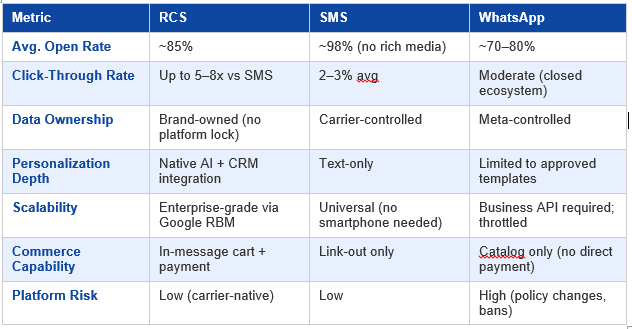
The critical differentiator is data sovereignty. WhatsApp gives Meta visibility into your customer engagement patterns. SMS data lives in carrier logs you don't control. RCS conversations when routed through your own platform and generate first-party behavioral data that you own, enrich, and act on. In an era where customer data strategy is a boardroom conversation, this is not a minor footnote.
What Competitors Won't Tell You About RCS
Any credible strategic assessment requires confronting the friction points that RCS vendors tend to gloss over:
Android-First Reality (Until Recently)
For years, RCS was effectively an Android-only channel, limiting addressable audience for brands with mixed iOS/Android customer bases. Apple's adoption of RCS in iOS 18 (September 2024) changes this but iMessage-style features (end-to-end encryption, reactions) are not part of the base RCS standard, and enterprise RCS use cases are still maturing on iOS. Brands should model RCS penetration by device mix and phase rollout accordingly.
Carrier Fragmentation and Aggregator Dependency
Google's RCS Business Messaging (RBM) platform has standardized much of the delivery infrastructure, but enterprise-grade RCS still requires working with aggregators who have established carrier relationships. Not all aggregators offer the same SLA, throughput guarantees, or fallback logic. Evaluating aggregator infrastructure is as important as evaluating the channel itself.
The Misconception of 'Easy Migration'
RCS is not a drop-in SMS replacement. The conversation design is fundamentally different, it requires interactive flow design, CRM webhook architecture, and fallback SMS logic for non-RCS devices. Brands that treat it as a channel swap (same message, different pipe) consistently underperform. The value is in the interaction design, not just the delivery mechanism.
Spam Risk and Brand Safety
RCS's rich media capabilities lower the perceived barrier to promotional messaging, which increases the risk of customer fatigue if frequency and relevance are not managed rigorously. Unlike WhatsApp's strict template approval system, RCS messaging guidelines vary by carrier and a poor experience on RCS has higher reputational cost because it occurs in the native messaging app.
Contrarian Take: The brands that will lose on RCS are those that migrate their SMS strategy as-is. The brands that will win are those that redesign the conversation from first principles.
RCS vs SMS vs WhatsApp: The Strategic Comparison
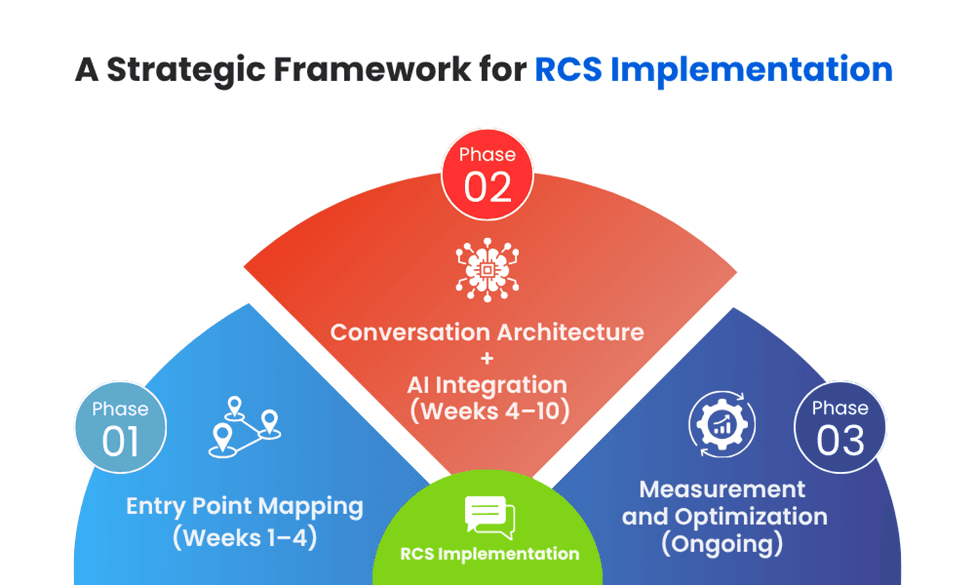
Successful RCS rollouts share a common architecture. Here's a phased approach that enterprise CX and marketing leaders can use as a baseline:
Phase 1: Entry Point Mapping (Weeks 1–4)
Before writing a single message, map the moments where RCS adds disproportionate value. Ask: where in the customer journey does interactivity, rich media, or in-channel action directly accelerate conversion or reduce drop-off? Common high-ROI entry points include:
• Post-ad-click engagement flows (Google Ads → RCS opt-in)
• Website chat handoff to RCS for mobile visitors
• CRM trigger-based lifecycle messages (abandonment, renewal, upsell)
• Inbound service request flows (replace IVR with RCS menus)
Phase 2: Conversation Architecture + AI Integration (Weeks 4–10)
Design conversation flows that expect responses and act on them. Integrate with your CRM via webhooks so that every tap, reply, and selection updates the customer record in real time. Layer in AI for:
• Intent classification on free-text replies
• Dynamic content personalization based on CRM attributes
• Automatic escalation to human agents for high-value, complex queries
Phase 3: Measurement and Optimization (Ongoing)
Define RCS-specific KPIs that go beyond open rates. Track: in-message conversion rate, thread completion rate, fallback SMS rate (indicator of audience coverage gaps), and CRM data enrichment rate per campaign. Run A/B tests on interactive element design such as the tap target, not the headline, is often the highest-leverage optimization variable.
The Future of RCS: Where the Channel Is Heading
The trajectory of RCS intersects with three macro-trends that will define business messaging over the next three to five years:
AI-Native Conversations
The integration of large language models into RCS flows transforms the channel from scripted decision trees into genuinely adaptive conversations. A customer asking 'What's the best option for me?' within an RCS thread can receive a contextually accurate, CRM-informed answer without human intervention. This is the commercial-grade application of conversational AI that enterprise teams have been waiting for.
Zero-Party Data as a Competitive Moat
As third-party cookies complete their deprecation cycle and consent requirements tighten globally, the brands with rich first-party and zero-party data profiles will have structural advertising and personalization advantages. RCS, by design, is a consent-native, interaction-rich data collection channel. Every optimized RCS program is simultaneously a zero-party data program.
Omnichannel Orchestration as the New Baseline
RCS will not replace email, WhatsApp, or voice. It will become the high-intent mobile layer in a coordinated omnichannel stack triggered by the right behavioral signal, delivering the right interactive experience, and handing off seamlessly to the right channel when complexity demands it. The winning architecture is not 'RCS or X' it's 'RCS when the interaction requires it.'
Conclusion: The Channel That Compounds
RCS messaging for business is not a trend to monitor — it's a compounding infrastructure investment. Every customer interaction builds a richer behavioral profile. Every optimized flow improves the next one. Every first-party data point strengthens your targeting, personalization, and retention capabilities.
The enterprises that are moving now building conversation architectures, integrating AI, and designing for interactivity are creating advantages that are genuinely difficult to replicate 18 months later. The channel is live. The audience is there. The only remaining variable is execution.
Chat360 is built for enterprises that are ready to operationalize RCS as a revenue channel not a messaging upgrade. From CRM-native conversation flows to AI-powered personalization to carrier-grade delivery infrastructure, our platform is designed for the conversation architecture that modern CX demands.